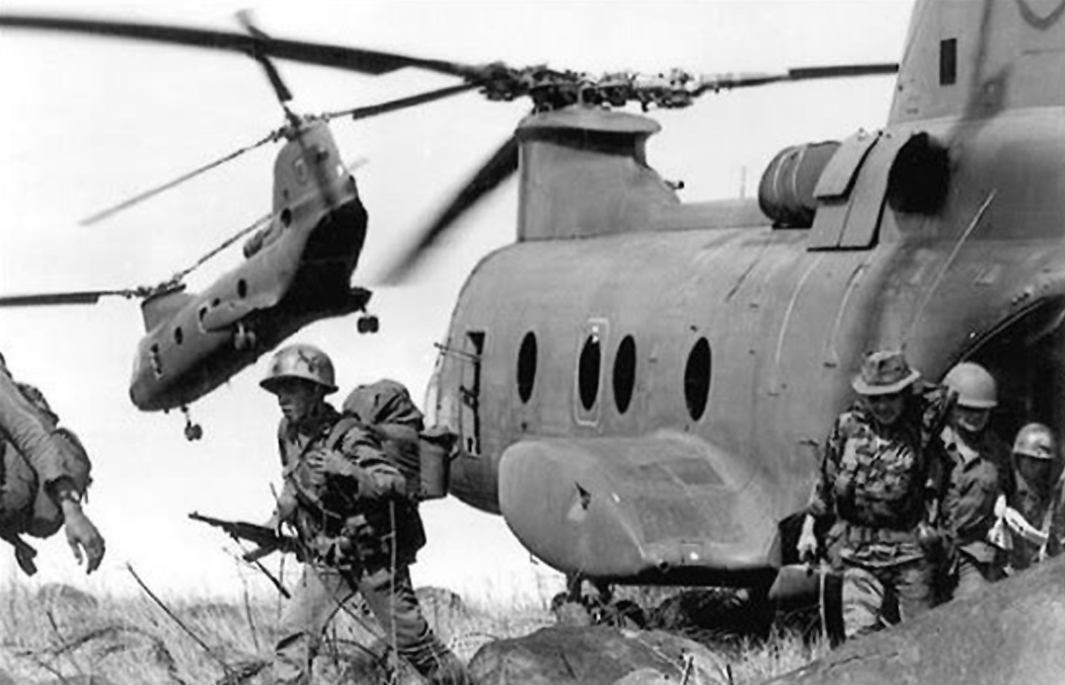
ARVN troops disembark from an American helicopter during Operation Lam Son 719, Spring 1971.“American aircrews soon found themselves flying against some of the most intense anti-aircraft and ground fire they’d faced in Southeast Asia.”
By Larry Freeland
IN 1967, the noted American novelist John Steinbeck was sent by Newsday to cover the war in Vietnam. On Jan. 7 of that year, he was at Pleiku, where he flew aboard a UH-1 Huey helicopter with D Troop, 1st Squadron, 10th Cavalry.
He wrote the following about helicopter pilots:
“I wish I could tell you about these pilots. They make me sick with envy. They ride their vehicles the way a man controls a fine, well-trained quarter horse. They weave along stream beds, rise like swallows to clear trees, they turn and twist and dip like swifts in the evening. I watch their hands and feet on the controls, the delicacy of the coordination reminds me of the sure and seeming slow hands of (Pablo) Casals on the cello. They are truly musicians’ hands, and they play their controls like music and they dance them like ballerinas and they make me jealous because I want so much to do it. Remember your child night dream of perfect flight, free and wonderful? It’s like that, and sadly I know I never can. My hands are too old and forgetful to take orders from the command center, which speaks of updrafts and side winds, of drift and shift, or ground fire indicated by a tiny puff or flash, or a hit, and all these commands must be obeyed by the musician’s hands instantly and automatically. I must take my longing out in admiration and the joy of seeing it. Sorry about that leak of ecstasy, Alicia, but I had to get it out or burst.”
Helicopters were a vital component in America’s overall military strategy in Vietnam. Over the 13 years that Americans served and fought in Southeast Asia, approximately 12,000 helicopters from all services saw action with the U.S. Army being the main operator of them. A total of 5,086 helicopters were destroyed – a loss rate of 42 per cent. Many of the rest were damaged in action. More than 40,000 helicopter pilots and 60,000 crew members served in Vietnam. During the war, 2,165 pilots and 2,712 crew were killed. Many more were wounded. When totalled, the number of pilots and crew members killed represents over 8 per cent of the men and women whose names are inscribed on the Vietnam Memorial in Washington, D.C.
Vietnam helicopter pilots and their crews were a special breed. They risked their lives every day, often to save men they did not know, and in most cases would never meet.
American troops board a UH-1 Huey, 1970. (Image source: WikiMedia Commons)“The grunt (infantrymen) is the true reason for the existence of the helicopter,” pilots would often tell one another. “Every helicopter that flew in Vietnam had one real purpose: To help the grunt.”
Flying dangerous and deadly missions was the daily routine. In fact, the average life expectancy of a helicopter pilot and crew in Vietnam was just 30 days; during a major battle or when flying into or out of a hot landing zone that time-frame might drop to mere minutes. And combat wasn’t the only danger chopper crews faced; mechanical failures, human error and even poor flying conditions also cost lives.
In February and March of 1971, the U.S. military conducted Operation Lam Son 719 in the northwest corner of South Vietnam
It would prove to be the costliest period in the Vietnam War for American helicopter crews.
I was there and flew CH-47 Chinooks, as part of the 101st Airborne Division Combat Aviation Group.
(Image source: WikiMedia Commons)Lam Son 719 was organized to stop the flow of men and supplies down the Ho Chi Minh Trail in southern Laos. The job of the 101st Airborne’s helicopter force, numbering over 600 machines, was to support the South Vietnamese ARVN forces operating in Laos.
The American helicopters were augmented by other U.S. aviation units in South Vietnam. ARVN armour and infantry, numbering over 20,000 men, were to advance along Route 9, a narrow dirt road in Laos. Along the way, South Vietnamese forces established several firebases and landing zones (LZs) on the highest ridge lines and peaks in the area. Their purpose was to guard the flanks of the advancing ARVN units along Route 9 as they pushed deeper into Laos and engaged the enemy. In essence, South Vietnamese forces did the groundwork and fighting inside of Laos, and the Americans provided air support. Lam Son 719 was supposed to last 90 to 120 days. It was to be the first real test of Vietnamization, the Nixon Administration plan to turn the war over to South Vietnam. The campaign ended in failure after only 60 days.
During Lam Son 719, U.S. planners believed that any North Vietnamese Army (NVA) forces opposing the incursion would be caught in the open and destroyed by the application of American airpower, specifically tactical airstrikes and air mobility. Although U.S. planes and helicopters played an important role in the operation, their contribution would not be decisive. It would however prevent the South Vietnamese defeat from becoming a complete disaster. Despite this, American helicopter crews would pay a terrible cost. Many of them who flew in and out of Laos estimated their odds of survival were little better than 50/50.
ARVN forces on the move. (Image source: WikiMedia Commons)After entering Laos, ARVN forces faced heavy enemy resistance. American aircrews soon found themselves flying against some of the most intense anti-aircraft and ground fire they’d faced in Southeast Asia. During their missions, they flew through machine gun, small arms and RPG fire. Their LZs were frequently targeted by enemy mortar rounds and artillery shells, and in some cases were threatened by enemy tanks.
Both crews and aircraft took heavy losses. After America’s six years of combat operations in Southeast Asia, no one wanted to be the last man to die in Vietnam.
The operation was officially called off April 7, 1971, having fallen well short of its objectives. Despite this, that same day, President Nixon appeared on television to declare victory for his administration’s strategy.
“Tonight, I can report that Vietnamization has succeeded,” he proclaimed.
South Vietnamese President Thieu echoed Nixon’s sentiments. While addressing the survivors of Lam Son 719 at Dong Ha, he claimed that the operation in Laos was “the biggest victory ever.”
An American CH-53 lifts a bundle of supplies. (Image source: WikiMedia Commons)More than 750 American helicopters took part in Lam Son 719, flying 160,000 sorties. Most of the choppers came from the 101st Airborne. The division lost 84 machines in the campaign, with another 430 damaged. A fifth of those were rendered inoperable. Combined helicopter losses totaled 108 machines destroyed and 618 damaged. During the two months of flight operations, 72 helicopter aircrew members were killed, 59 were wounded and 11 were missing.
The United States military was shocked and unprepared for the staggering loss of men and equipment. The toll was so heavy, advocates of U.S. Army aviation were forced to re-examine the basic air mobility doctrine and tactics. Particular attention was directed toward the combat survivability of helicopters in hostile environments.
Although the campaign did set North Vietnamese supply operations in southeastern Laos back for a time, truck traffic on the trail system increased almost immediately. Washington and Saigon’s claims of success rang hollow, the operation having exposed grave deficiencies in ARVN “planning, organization, motivation, operational expertise, and most importantly leadership.”
For the North Vietnamese, Lam Son was viewed as a complete victory. The military expansion of the Ho Chi Minh Trail to the west, which had begun in 1970, accelerated. The area that the trail passed through in southeastern Laos expanded from 60 miles in width to 90 miles.
NVA artillery in action during the 1972 Easter Offensive. (Image source: WikiMedia Commons)The victory also convinced Hanoi to plan for an invasion across the DMS into South Vietnam’s Quang Tri province in early 1972, known in the west as the Easter Offensive.
Had it not been for massive amounts of American airpower deployed in the defense of the South, the 1972 invasion might have ended the war that year, with a complete victory for Hanoi. It would take another three years to achieve final victory.
It is against the backdrop of Operation Lam Son 719, I chose to write a novel about American helicopter pilots at war in the later part of the Vietnam conflict.
About the Author: Larry Freeland is the author of Chariots in the Sky: A Story About U.S. Assault Helicopter Pilots at War in Vietnam. A veteran of the war in Southeast Asia, he served with the 101st Airborne Division as an infantry officer and CH-47 helicopter pilot. He has been a banker, financial consultant, college instructor. He is retired and lives in Georgia. He is currently working on a historical fiction Trilogy about one family’s three generations of men who serve in the military starting with WWI to the present. You can visit his website at larryfreeland.com.
Help spread the word. Share this article with your friends.Like this:Like Loading...
Related