In the mid-1950s, the front page of the Wall Street Journal ran a story about companies building free-wheeling “think” panels to mine ideas. Ethyl, the paper said, got 71 ideas in 45 minutes. Reynolds Metals used the same method for marketing plans.
The method had a name that sounded like a military assault: brainstorming. And it came out of Madison Avenue.
I’m Damon Nelson. I’ve been a marketer and developer for more than 30 years. People still talk about the “Mad Men” era as if creativity walked into the room with a cigarette and a punchline. The real story of how those agencies tried to invent ideas on purpose is plainer, and more useful.
It started at BBDO
Alexander Faickney Osborn was chairman and cofounder of Batten, Barton, Durstine & Osborn (BBDO). According to Samuel W. Franklin’s account in Lapham’s Quarterly (drawn from Franklin’s book The Cult of Creativity), Osborn was not known in the trade as a “creative man”—the industry label for a copywriter or artist. He still believed he had found a workable way to think up slogans and marketing concepts when the usual people were stuck.
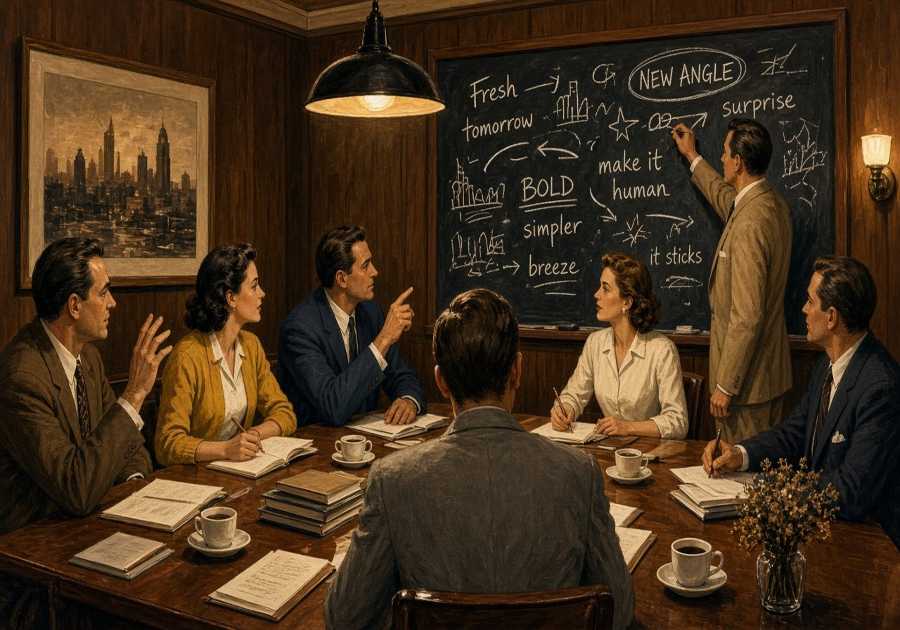
In 1942 he published a slim book, How to Think Up, that introduced “brain-storming.” When BBDO executives were stumped, they would gather about a dozen younger staff and a few “brass hats” after work. Once everyone was relaxed, a chairman posed the problem and asked the group to call out ideas as fast as they could. Criticism was forbidden. “Freewheeling” was encouraged. People were told to build on one another’s suggestions. Quantity came first. A secretary wrote everything down. Later, in daylight, an executive sorted the good from the bad.
The name was meant to sound like troops storming a beach. For the length of the session, hierarchy was suspended—“all are equal”—even though the sorting happened afterward by people with titles.
OSBORN SPLIT THE JOB IN TWO: IMAGINE FIRST, JUDGE LATER.
Why the 1950s made it famous
Osborn kept publishing. Your Creative Power appeared in 1948. Wake Up Your Mind came in 1952. Applied Imagination, in 1953, became the “bible” of the creative-thinking movement. In 1954, at sixty-six, he left BBDO and founded the Creative Education Foundation to spread the method through literature, trainers, and an annual Creative Problem-Solving Institute in Buffalo.
Between late 1955 and 1958, Franklin writes, brainstorming was everywhere. The December 5, 1955, Wall Street Journal front page described free-wheeling panels mining ideas from lower ranks. In May 1956, major magazines and papers covered the Navy bringing in Charles H. Clark of the Ethyl Corporation—an Osborn associate—to stir “more Washington imagination.” By 1958, Osborn listed dozens of companies that had reportedly set up creative-thinking programs, from IBM and RCA to Kraft, Shell Oil, and Union Carbide.
That is the Mad Men-era method in documented form: not a lone genius waiting for lightning, but a timed room with rules designed to keep judgment from killing the next line before it was spoken.
What it was not
It was not the later Creative Revolution story of Doyle Dane Bernbach’s art-director-and-copywriter teams, which began when DDB was founded in 1949 and flowered in the 1960s. Smithsonian’s American Enterprise material on Madison Avenue describes that later shift as valuing creativity over market research and pairing writers with artists. Osborn’s brainstorming was a different tool—group ideation under a ban on criticism—sold from an agency into corporate America, government, and the military.
It also was not a claim that every slogan came from a panel. Osborn’s own books treated creative thinking as a skill anyone could practice. Critics then, and later, called brainstorming a fad. The point for marketers is simpler: Madison Avenue tried to industrialize idea generation with a process you can still recognize in every whiteboard session today.
How to use it in your business
Here’s the lesson I take from it. Separate the inventing from the judging. Osborn’s rooms worked—when they worked—because criticism waited. The list got long first. Evaluation came second.
How to use it: When you need copy, offers, or angles, run a short session with one problem statement, a ban on “that won’t work,” and a person whose only job is to write every idea down. Do not sort in the room. Sort the next morning. If your meetings kill ideas the second they appear, you are running the judicial half of the job during the imaginative half. That is the opposite of what BBDO’s method was built to fix.
Sources
- Samuel W. Franklin, “The Birth of Brainstorming,” Lapham’s Quarterly, May 17, 2023 (excerpted from The Cult of Creativity, University of Chicago Press, 2023): https://www.laphamsquarterly.org/roundtable/birth-brainstorming
- Smithsonian National Museum of American History, “Madison Avenue, 1940s–1960s,” American Enterprise online exhibition: https://www.americanhistory.si.edu/explore/exhibitions/american-enterprise/online/advertising-business/madison-avenue
- Doyle Dane Bernbach founding and creative-team pairing, as summarized in period DDB oral histories collected by Joseph Iozzi: https://www.josephiozzi.com/images/100%20DDB%20stories%20from%20the%2060s.pdf