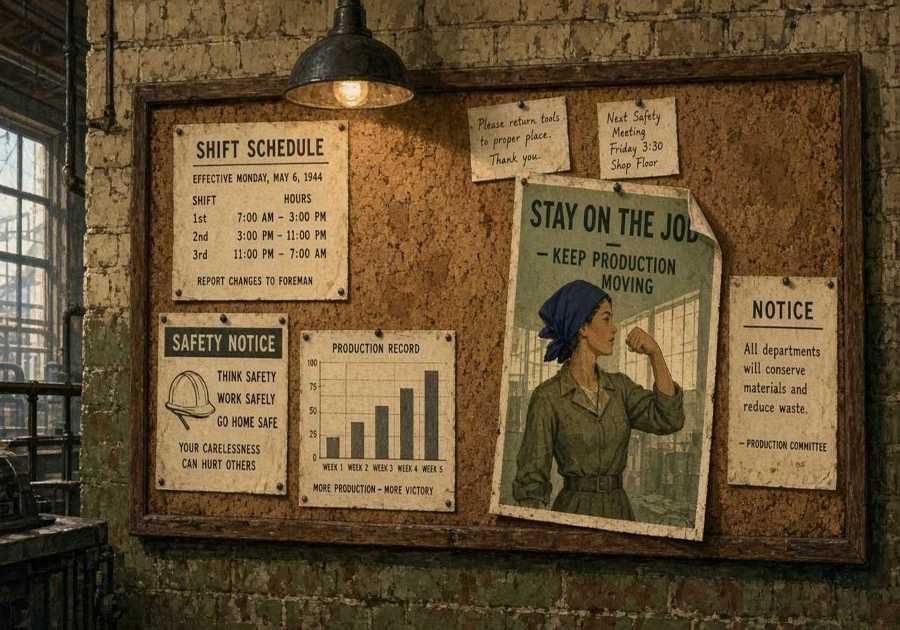
In February 1943, a poster went up inside Westinghouse factories. A woman in work clothes flexed her arm under four words: "We Can Do It!" About two weeks later, it came down so the next poster in the series could go up.
It was not a public recruitment ad. It was an in-house work-incentive poster. The people meant to see it already worked there.
I'm Damon Nelson. I've been a marketer and developer for more than 30 years, and this image is worth knowing for a reason most tellings skip. Here's what it was made to do, how it got a name the artist never gave it, and the lesson I take from that.
What it was made to do
J. Howard Miller, a Pittsburgh artist, was hired in 1942 to create in-house posters for Westinghouse. He made at least 40 posters in the series. They were work-incentive posters, made to raise productivity and ease labor-management tension that could lead to strikes. That reading comes from a 2006 paper by Kimble and Olson, which Michelle C. Smith discusses in JSTOR Daily.
The posting instructions called for "We Can Do It!" to be displayed in Westinghouse factories for two weeks in February 1943. It hung on a factory wall. Then it came down.
TWO WEEKS INSIDE THE PLANTS. NOT A PUBLIC AD.
The woman had no name
The woman in Miller's poster had no name. "Rosie the Riveter" came from a 1943 song by Redd Evans and John Jacob Loeb, and from Norman Rockwell's Saturday Evening Post cover dated May 29, 1943. Those are separate works. Miller's poster did not call her Rosie.
THE NAME CAME FROM SOMEWHERE ELSE.
How the label stuck
The poster went into the National Archives, in the War Production Board records, as record group 179, local ID 179-WP-1563. You can see the record on the National Archives page for "We Can Do It!".
In the late 1970s, the National Archives sold it as a postcard with no "Rosie" label on it.
In 1982, in its catalogue, Helaine Victoria Press, a feminist postcard press, labeled it "Photo of WWII 'Rosie' poster." That was the first link between Miller's image and the name. In 1985 the press printed its own card saying images like "Rosie the Riveter" were used to recruit women. That claim is the myth that stuck. Miller's poster was an internal work poster, not a campaign to hire women from the public.
The image spread easily in part because, as JSTOR Daily notes, Miller's poster could be reused freely, unlike Rockwell's copyrighted Rosie.
What happened to Miller
Late in life, Miller sold his Westinghouse posters to the Smithsonian's National Museum of American History for $75 each, including this one. He died on September 2, 1985, four days after the Smithsonian approved the purchase. He never saw the poster become an icon.
Even the woman in the image was misidentified for years. James J. Kimble presents a captioned photo of Naomi Parker (later Fraley) of Alameda, California, as the one believed to be the poster's basis. That is how he presents the evidence. It is not a certainty, and it does not treat Geraldine Hoff Doyle as the model.
How to use it in your business
Here's the lesson I take from it. Your audience can rename your message. The label someone else gives it can outlast your original intent.
How to use it: When you put out a message, even a narrow one for people already on your team or on your list, watch the name that starts traveling with it. If someone else's label changes what you meant, say what you meant, in plain words, before that label hardens. And keep the origin story honest. If something ran for two weeks inside a factory, don't later describe it as a national recruitment campaign.
Sources
- Michelle C. Smith, "Was She Really Rosie?" JSTOR Daily, 2023: https://daily.jstor.org/was-she-really-rosie/
- National Archives, "We can do it!, ca. 1942" (RG 179, local ID 179-WP-1563): https://www.archives.gov/research/still-pictures/highlights/we-can-do-it
- Seton Hall University, "Creator of 'We Can Do It!' Poster Uncovered" (2022), on James J. Kimble's research: https://www.shu.edu/human-development-culture-media/news/creator-of-we-can-do-it-poster-uncovered.html
- James J. Kimble and Olson, "Visual Rhetoric Representing Rosie the Riveter," Rhetoric & Public Affairs (2006): https://muse.jhu.edu/pub/26/article/210135
- The Saturday Evening Post, "Rosie the Riveter" artwork page (Norman Rockwell cover, May 29, 1943): https://www.saturdayeveningpost.com/artworks/rosie-the-riveter/