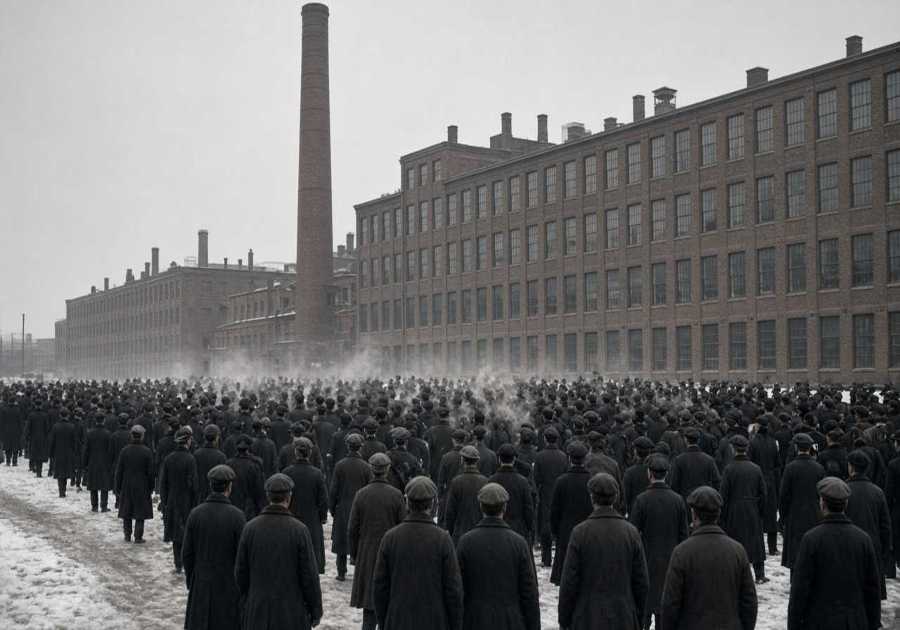
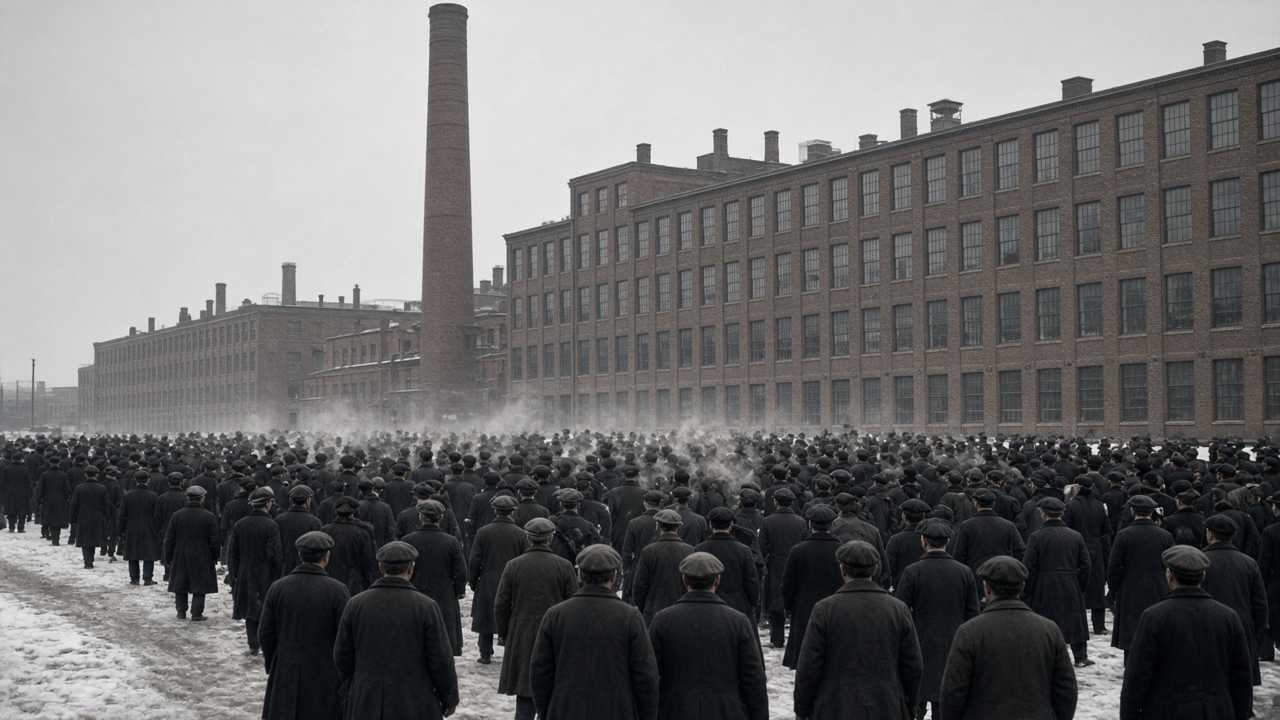
On January 5, 1914, Ford Motor Company made an announcement that opened like this: "The Ford Motor Company, the greatest and most successful in the world, will on January 12, inaugurate the greatest revolution in the matter of rewards for its workers ever known to the industrial world."
The terms were simple on paper. The workday would drop from 9 hours to 8. Minimum daily pay would rise from roughly $2.34 to $5 for workers who qualified.
I'm Damon Nelson. I've been a marketer and developer for more than 30 years, and this story is for anyone who has replaced the same contractor or VA more times than they'd like to admit. The $5 day is famous as a story about generosity. The record says it was a story about churn, with a catch.
370 percent
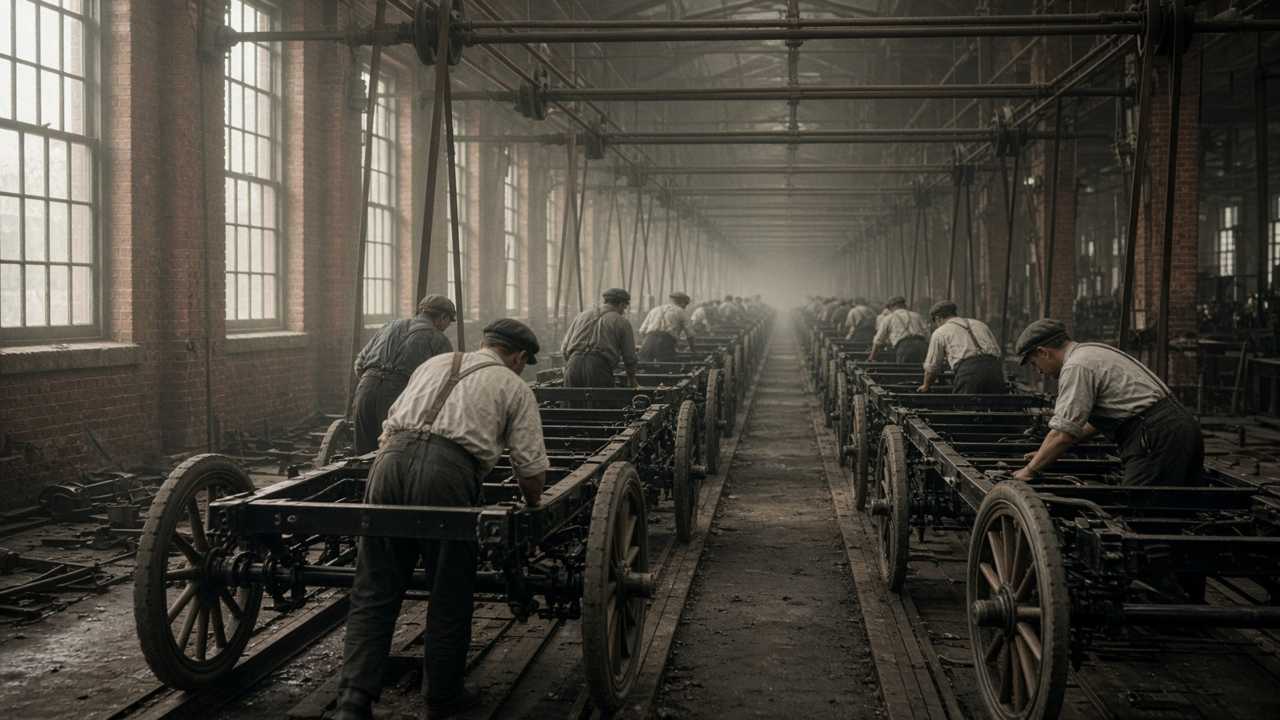
The moving assembly line came to Ford in stages in 1913. It made the work faster and more monotonous. Matt Anderson of The Henry Ford writes that it cut the time to build a Model T from 12.5 hours to 93 minutes. A line like that needs a steady crew.
Ford didn't have one. Economist Sumner Slichter's figures, as reported by Daniel Raff and Lawrence Summers, show that in 1913 Ford had 50,448 people leave in order to keep an average force of 13,623. That's an annual turnover rate of 370 percent. In Detroit, 200 percent was already common. Ford was high even there.
Most leavers didn't quit out loud. Of the just over 7,300 who left in March 1913, 71 percent were "five day men," who missed five days in a row without excuse and were counted as gone.
On October 6, 1913, 1,250 of 12,548 workers were absent. That's 10 percent of the plant missing on one day.
MORE THAN THREE DEPARTURES PER SEAT PER YEAR.
The first fix came in October
The $5 day wasn't Ford's first move. In the summer of 1913, John R. Lee studied why workers were unhappy. His list ran from long hours and low pay to, "last and perhaps the most important," unintelligent handling by foremen and superintendents.
On October 1, 1913, Ford raised wages 15 percent across the board, cleaned up a chaotic pay structure, and set up a central Employment Department so a foreman could no longer fire people at will. Turnover dropped in October. Then, Raff and Summers write, it "appears to have risen sharply again in November and December." January was the second stage.
Most of the $5 was a bonus
The extra money was labeled profit sharing, not a raise. Anderson makes the point that gets lost in the headlines. If a worker had been making $2.30, that was still his wage. The rest was a bonus of $2.70, paid if the company's requirements were met.
And not everyone could meet them. At the start, the plan was for men over 22. Younger men got in if they were married or supporting a mother or siblings. Women were left out. The New York Times, after talking with Ford officials, reported on January 7, 1914, that women were not, "as a rule, the heads of families," and that it was "understood that there are no women or girls in the Ford plant who come under this classification. If there should be, they undoubtedly would be taken care of."
A six-month service rule came later. Raff and Summers note it was "not brought in until the following autumn."

Then someone came to your house
The third condition was a home investigation. A 1914 Ford pamphlet said it plainly: "A worker is only put on the list of profit sharers after he has been carefully looked up and the company is satisfied that he will not debauch the additional money he receives."
Investigators from Ford's Sociological Department visited homes. They asked about cleanliness, boarders, school attendance and bank deposits. The official message covered baths, clean and uncrowded housing, no excessive drinking or gambling, no "unwholesome foods," and regular savings. The company could hold back the bonus until "violations" were fixed. A worker who complied within 30 days got the full payments back.
Counts of investigators vary, from fifty to 200, depending on who you read.
Lee, writing in 1916, said 69 percent of the workforce qualified in the first six months, 87 percent after a year, and 90 percent by mid-1916. Ford later claimed all but 1 percent got at least $5 a day. Those two accounts don't match. I'd trust Lee's numbers over the company line.
Workers took the money. Anderson writes that they came to resent the visits, and that by 1921 the department "was largely dissolved."
THE HEADLINE SAID $5. THE FINE PRINT SAID INSPECTION.
What changed
Turnover fell from 370 percent in 1913 to 54 percent in 1914 and 16 percent in 1915. On October 6, 1914, only 311 of 12,645 workers were absent, about 2.5 percent. Profits went from $27.1 million in 1913 to $31.8 million in 1914 and $40.3 million in 1915.
Ford later called the $5 day "one of the finest cost cutting moves we ever made." That's his claim, not an audit.
The raise didn't do it alone
Here's the part the legend leaves out. A recession was underway. Raff and Summers note that the Detroit downturn "may have accounted for up to half of the decline in turnover between 1913 and 1914." The October reforms were in the mix too. How much credit goes to the pay, the earlier changes and the recession is still not settled.
The cost was real, too: an estimated $10 million in a year when profits were forecast at about $20 million. Counting training costs alone, Raff and Summers figure lower turnover saved about 16 cents per worker per day, a small share of the extra wages. But they add that turnover cost more than training: staffing you can't plan, and the drag of discontent on the people who stayed.
What about selling cars to the workers?
You've probably heard that Ford raised pay so his own people could afford Model Ts. The record doesn't support that as the reason.
Anderson writes that Ford "slyly observed" he had also created a new pool of customers. That's a later remark about a side effect. The math is against it as a plan. Ford built 202,667 cars in the U.S. in 1913 and 308,162 in 1914. Its average force was about 12,100 in 1914. Even if every worker bought one, it would be a small slice of output.
How to use it in your business
Here's what I take from it. Ford acted on a measured cost. He knew how many people walked out the door, and he knew how many didn't show up.
Most small teams will never see 370 percent turnover. You still pay for churn, in training time, missed handoffs, work that gets redone, and customers who notice the revolving door.
Borrow the right lesson. Ford fixed how people were hired and fired before he raised the rate. A recession helped. And the surveillance bought stability and resentment at the same time.
How to use it: Before you change what you pay a contractor or VA, count how many you've replaced in the last year and how long each took to get up to speed. Price the whole cost of replacing someone, not only the hiring fee. Fix the mess around the work (unclear handoffs, firing on a whim) before you assume pay is the problem. And if better pay comes with conditions, say so up front.
Sources
- Daniel M. G. Raff and Lawrence H. Summers, "Did Henry Ford Pay Efficiency Wages?" NBER Working Paper 2101, December 1986: https://www.nber.org/system/files/working_papers/w2101/w2101.pdf
- Matt Anderson, "Ford's Five-Dollar Day," The Henry Ford, January 3, 2014: https://www.thehenryford.org/collections/explore/articles/fords-five-dollar-day
- The Henry Ford, "Crowd of Applicants outside Highland Park Plant after Five Dollar Day Announcement, January 1914": https://www.thehenryford.org/collections/explore/artifact/35765
- The Henry Ford, "Ford Sociological Department & English School": https://www.thehenryford.org/collections/explore/popular-research-topics/ford-motor-company-sociological-department-english-school
- The Henry Ford, AskUs research guide, "Ford Motor Company Production Statistics": https://askus.thehenryford.org/researchguides/faq/375607
- Elena Loizedes and Subhash Sonnad, "Fordist Applied Research in the Era of the Five-Dollar Day," Grand Valley State University McNair Scholars Journal: https://scholarworks.gvsu.edu/cgi/viewcontent.cgi?article=1009&context=soc_articles