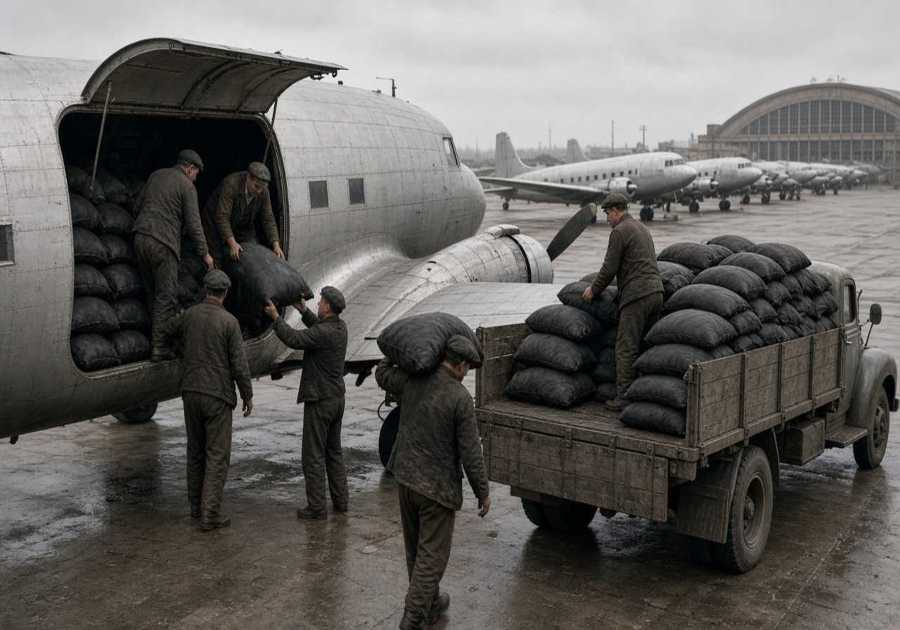
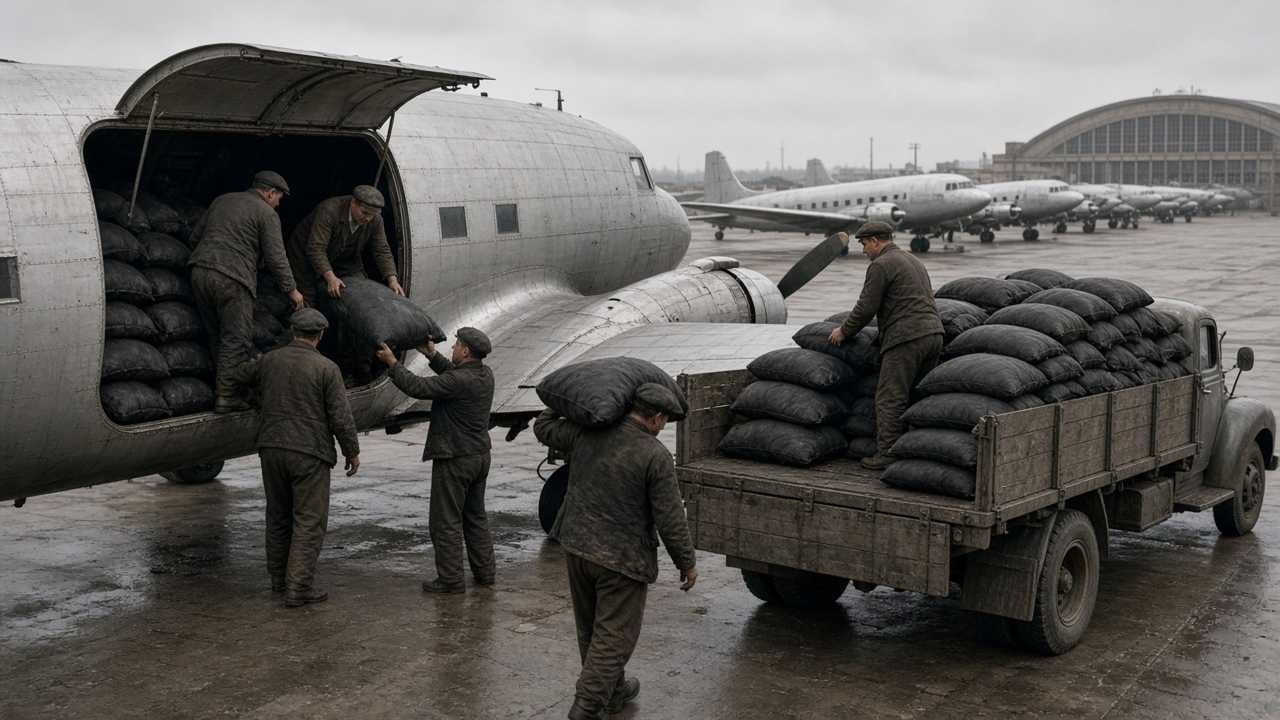
Over Easter weekend 1949, usually dated April 16, a plane landed at one of Berlin's three airfields every 62 seconds. In 24 hours, Allied crews flew 1,398 flights into the city and delivered 12,941 tons.
There was no general announcement of the goal ahead of time, so a miss wouldn't be embarrassing.
I'm Damon Nelson. I've been a marketer and developer for more than 30 years, and this story is for anyone running work that repeats: orders, posts, support tickets, a campaign sprint. Here's how one general picked a single number, ran his whole operation to a clock, and posted the score where everyone could see it.
A city cut off
West Berlin sat about 110 miles inside the Soviet zone. In June 1948, after a Western currency reform, the Soviets closed the land, rail and water routes in steps between June 19 and 29. The West could abandon the city, cancel the reform, force a land corridor and risk war, or fly. They flew.
The U.S. start is usually given as June 26, 1948. Berlin's AlliiertenMuseum dates the first flights carrying goods for the population to June 28, with 268 short tons that day. The early planning number was about 4,500 tons a day of coal and food.
"I expect you to produce"
Maj. Gen. William H. Tunner had run the World War II "Hump" airlift. He arrived in Wiesbaden on July 28, 1948, and reported to Lt. Gen. Curtis E. LeMay, who told him, "I expect you to produce." Tunner answered, "I intend to."
What he found, he said later, was a temporary operation, with crews who couldn't say when they were supposed to eat or sleep.
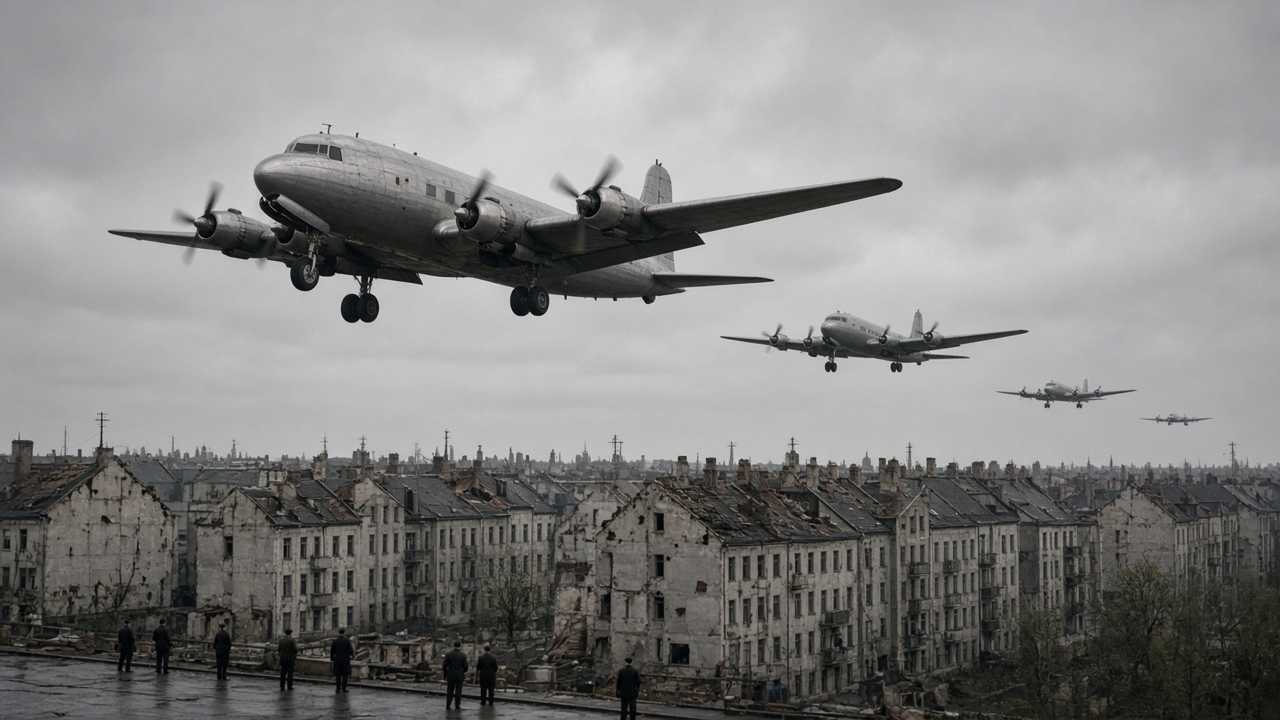
He turned it into a conveyor belt. Planes flew in on the northern and southern corridors and out on the middle one. Every takeoff time, altitude and speed was set, and the stream entered the corridor at three-minute intervals, in all weather. In historian Daniel F. Harrington's words, the system left "no room... for individuality." The pilots themselves suggested the timing method, in a "gripe session."
Black Friday and the no-stack rule
On August 13, 1948, rain blinded Tempelhof. Three aircraft were wrecked or damaged on the field. Nearly two dozen more circled in cloud, stacked up over Berlin, and the U.S. lift "stumbled to a halt." Tunner was in the stack himself.
He sent the other planes back out the corridor and banned stacking. From then on, a plane that missed its Berlin approach didn't circle. It flew out the middle corridor, cargo still aboard, and started over. One wasted trip protected everyone behind it.
MISS YOUR APPROACH. GO HOME LOADED.
In mid-October, the Americans and British put the combined lift under Tunner. On October 20, 1948, the official target went up to 5,620 tons a day.
The scoreboard
Tunner measured one thing: tons delivered to Berlin. Not hours flown. Not planes in the air.
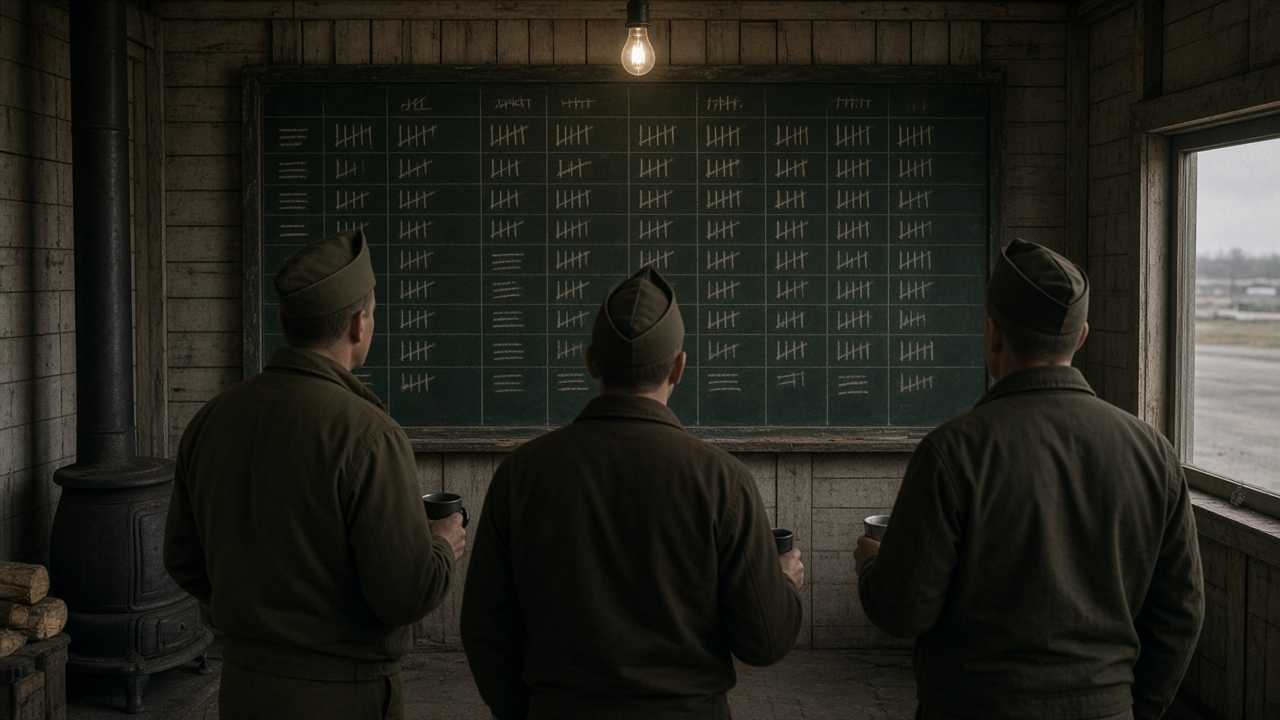
Then he made sure everyone saw it. The Task Force Times, a free daily sheet printed in Wiesbaden, ran from August 21, 1948, to August 3, 1949. Its "Howgozit Board" printed each unit's daily tonnage, "indirectly encouraging the individual units at the airports to compete with one another." The bases had physical Howgozit boards too, showing missions and tons.
He also stirred the rivalry in person. Two British-zone bases, Fassberg and Celle, flew the same work. Celle was 12 percent ahead of quota. At Fassberg, Col. Jack Coulter was 10 percent ahead. Tunner told him that was "not up to what they're doing over at Celle," and Coulter "raced back to the flight line."
The Easter Parade
By spring 1949 the lift was already beating its target. Tunner wanted a shock anyway: a 10,000-ton day, about 50 percent above the best day so far.
Maj. Gen. Robert W. Douglass, Jr., USAFE's chief of staff, worried a maximum effort would wear out the force. Tunner said the daily average would fall back from the peak but settle higher than before.
The crews blew past 10,000. Harrington records 12,941 tons in 1,398 flights between noon and noon, with a landing every 62 seconds. Tunner remembered it as having gone "without a single accident or incident."
The exact window depends on the source. A U.S. Army Transportation Corps table measures 1345 on April 15 to 1345 on April 16 and gets 12,177.12 short tons on 1,344 landings. The National Air and Space Museum has used 1,383 flights. The 12,941 and 1,398 figures are the ones Tunner and the USAFE history use.
And Tunner was right about the plateau. The daily average went from 6,300 tons in March 1949 to 7,850 in April and over 8,000 in May and June.
A RECORD DAY, THEN A HIGHER NORMAL.
Did the headlines end the blockade?
The record day was briefed to the press, and Tunner was pleased with the "worldwide headlines." The Soviets lifted the blockade on May 12, 1949.
Tunner connected those dots. In 1969 he said he would "always believe" the Easter Parade "convinced the Russians that there was no point to be gained by continuing." The AlliiertenMuseum says positive reporting on Allied tonnage was "certainly part of the reason" for the lifting of the blockade.
Those are judgments, not proof. The sources behind this story don't include Soviet decision papers. What I can say is this: the West made the airlift look like a machine that could run forever, and Moscow ended the blockade after that machine had already passed the city's daily need, including on a well-publicized record day. Whether the headlines tipped it is interpretation.
The final count
The airlift kept flying after May 12 to build a stockpile, and it closed out on September 30, 1949. The official USAFE tally, in Harrington's history, is 2,325,651.6 short tons in 277,682 flights. Coal was 1,586,029.3 tons, or 68.2 percent. Food was 536,847.3 tons. U.S. aircraft carried 1,783,572.7 tons and British aircraft 542,078.9. French flights for their own garrison are outside those totals.
It wasn't free. People died, and how many depends on who is counted. The AlliiertenMuseum says at least 78 people died in airplane accidents, and their names are on the Airlift Memorial at Tempelhof. Air Force Magazine wrote in 1998 that 77 men were killed, 31 of them Americans. The Air Mobility Command Museum says the U.S. Air Force lost 28 airmen, a narrower group. Harrington's lists mix military, civilian, British charter and German deaths, and the official lists don't agree in every category.
How to use it in your business
Here's what I take from it. Tunner picked a number that described the mission, not the activity. Tons on the ground, not planes in the air. Then he ran the work to a clock, refused the special case that would jam the line, and posted the score.
The scoreboard had two jobs. Inside, it made Celle and Fassberg race. Outside, it made the lift look like it could go on forever. That's powerful. It's also a promise, and you can only make it if the operation behind it can keep it.
Rivalry is tiring, too. Douglass's worry was fair, which is why Tunner argued for the plateau, not the peak.
How to use it: Pick one output number for your repeating work, orders shipped, posts published, tickets closed, and post it where the people doing the work can see it every day. Set a pace you can repeat tomorrow, not only on a heroic day. When something misses the cut-off, it goes on the next run instead of stalling the run for everyone. And if you show your number to customers, make sure it's the right number and that you can keep hitting it.
Sources
- Daniel F. Harrington, The Air Force Can Deliver Anything: A History of the Berlin Airlift, 1948-1949, United States Air Forces in Europe history office: https://www.govinfo.gov/content/pkg/GOVPUB-D301-PURL-gpo128527/pdf/GOVPUB-D301-PURL-gpo128527.pdf
- Daniel L. Haulman, "Operation Vittles," Air Mobility Command Museum: https://www.amcmuseum.org/history/operation-vittles-berlin-airlift/
- AlliiertenMuseum, "The Berlin Airlift 1948/49": https://www.alliiertenmuseum.de/en/thema/the-berlin-airlift-1948-49/
- berlinairlift75.org, "Easter Parade": https://www.berlinairlift75.org/en/easter-parade/
- berlinairlift75.org, "Setting up a combined task force": https://berlinairlift75.org/en/grundung-einer-gemeinsamen-task-force/
- berlinairlift75.org, "HOWGOZIT Board": https://berlinairlift75.org/en/howgozit-board/
- berlinairlift75.org, "A Record For All Time": https://www.berlinairlift75.org/en/a-record-for-all-time/
- "Newspaper 'Task Force Times' - Airlift," airlift-berlin.com: https://www.airlift-berlin.com/newspaper-task-force-times.html
- C. V. Glines interview with William H. Tunner, "William H. Tunner: Berlin Airlift Commander," American Heritage 20, no. 6 (October 1969): https://www.americanheritage.com/william-h-tunner-berlin-airlift-commander
- Stewart M. Powell, "Berlin Airlift," Air Force Magazine, June 1998: https://www.airandspaceforces.com/PDF/MagazineArchive/Documents/1998/June%201998/0698berlin.pdf
- U.S. Army Transportation Corps, "Operation Vittles: Tempelhof": https://transportation.army.mil/history/studies/berlin.html