
On April 26, 1956, a converted World War II tanker called the Ideal X left Port Newark, New Jersey, for Houston. Historian Brian J. Cudahy describes it as a rainy Thursday. On a frame above the deck rode 58 aluminum truck bodies, taken off their wheels and used as containers.
Five days later (one account says six), the boxes were lifted onto waiting trucks in Houston.
I'm Damon Nelson. I've been a marketer and developer for more than 30 years, and this story matters to anyone whose product has to work with somebody else's. The voyage gets the headlines. The change that lasted took more than a decade longer, and it wasn't a ship.
He didn't invent the box
Malcom McLean, the North Carolina trucker behind the Ideal X, did not invent the shipping container. Marc Levinson, the historian who wrote The Box, says the idea "has been around since the 1700s."
In Levinson's words, McLean "took an idea that was hundreds of years old, was almost universally judged to be uneconomic, and made it so that it can be generally applied." He also said this: "I get a kick out of reading reports that he was trying to change the world when mostly he was trying to make a buck."
How a trucker ended up with a tanker
The documented start is the early 1950s. Highways were jammed before the Interstate system, and McLean wanted to move his trailers by coastal ship instead. His first idea was to drive whole trailers onto ships. Then he dropped the chassis and wheels, because they wasted space on board. A stackable box was what was left.
U.S. rules wouldn't let a trucking company own a shipping line. So McLean sold the trucking firm, bought into the Pan-Atlantic Steamship Company, and converted a tanker.
The number everyone repeats
Levinson writes that when McLean's accountants ran the numbers, they put the cost of loading the Ideal X at 15.8 cents a ton, against $5.83 a ton to load an average break-bulk ship, where cargo went aboard piece by piece.
Two things to keep straight. That is McLean's own accountants' math, as Levinson reports it, not an independent audit. And it is loading cost, not the total cost of shipping.
15.8 CENTS A TON TO LOAD. THAT'S MCLEAN'S ACCOUNTANTS TALKING.

Then nothing fit together
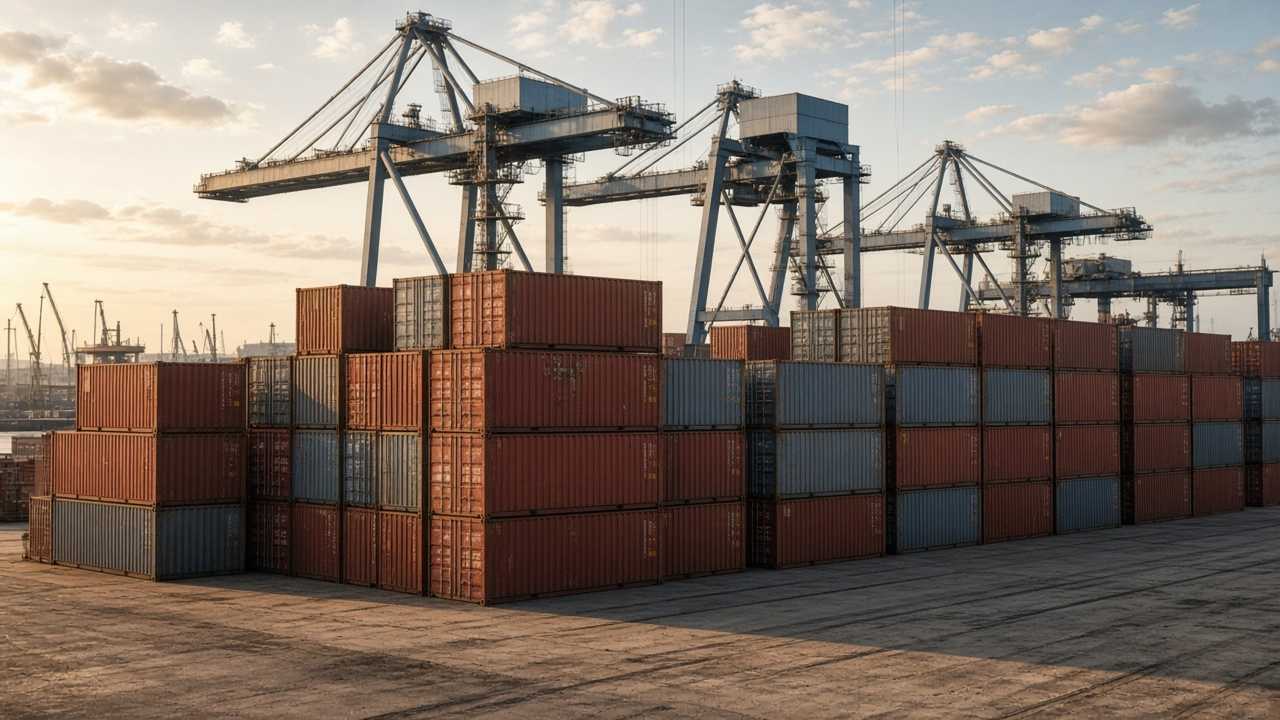
The box did not take over in 1956. By 1959, Levinson writes, the United States already had about 58,000 privately owned containers, most of them less than 8 feet long. Sea-Land's early boxes were 35 feet. Matson, on the West Coast, used 24 feet. Each design needed its own handling gear.
Levinson described those years to ISO this way: "It was not a network; it was just individual companies doing their thing. It wasn't convenient for the shipper, and it wasn't saving money."
He gave NPR a plain example. A factory packs a 33-foot box, but the ship at the pier only takes 40-foot boxes, or the crane at the other end can't handle that length. "What's going to happen to your container? It's going to sit there."
The fix was a shared corner
ISO set up its freight-container committee, TC 104, in 1961. McLean wasn't part of the early talks.
What he had was a better corner. His engineer, Keith Tantlinger, designed the corner fittings and the twistlock that let a crane operator latch on, lift, set down, and let go without anyone climbing onto the box. Sea-Land held the patents.
Tantlinger pressed the company to let them go. During the 1960s standards fight, McLean released Sea-Land's corner-fitting patents so any line and any port could use the same lifting and locking gear. Levinson: "He played a significant role by allowing free use of the patents. This permitted standardization, so the industry could grow quickly." ISO issued its Recommendation R 668 on container sizes in 1968.
ONE CORNER ANY CRANE COULD LIFT.
He gave away the handoff, not the business. Sea-Land still competed on ships, routes, and service.
Sea-Land's first transatlantic sailing came in April 1966. By the late 1970s, Levinson told NPR, the container was almost universal in international trade.
Who paid for it
The losers were real. Levinson writes that New York and London each had more than 50,000 registered dockworkers in the early 1950s. Old ports with covered piers and narrow streets lost the work to places with room for cranes and yards, like Newark and Elizabeth. The unions bargained for what they could, including a West Coast mechanization agreement in 1960 and an East Coast Guaranteed Annual Income program in 1965.
How to use it in your business
Here's what I take from it. A working prototype is not a network. The Ideal X proved a box could ride a ship. It took shared sizes and a shared corner before shippers could count on the next ship and the crane at the far end.
Incompatible handoffs eat the savings. And if the value lives in the handoff, hoarding the handoff can freeze the market you need. That doesn't mean give your product away. McLean opened the corner and kept fighting for every customer.
How to use it: List every place your product hands off to something you don't control (an export file, an integration, a format your customers already use). For each one, ask whether a customer can move work in and out without you. If the handoff is what's holding buyers back, make that part easy to share, and compete on everything else.
Sources
- Marc Levinson, "The Box That Shrank the World," Works That Work, no. 2: https://worksthatwork.com/2/intermodal-container
- Marc Levinson, "The North Carolina Trucker Who Brought the World to America in a Box," What It Means to Be American (Zócalo Public Square / Smithsonian), June 15, 2017: https://whatitmeanstobeamerican.org/journeys/the-north-carolina-trucker-who-brought-the-world-to-america-in-a-box/
- Betty Joyce Nash, "The Voyage to Containerization," Federal Reserve Bank of Richmond, Region Focus, Second/Third Quarter 2012: https://richmondfed.org/-/media/richmondfedorg/publications/research/econ_focus/2012/q2-3/pdf/economic_history.pdf
- Brian J. Cudahy, "The Containership Revolution: Malcom McLean's 1956 Innovation Goes Global," TR News 246 (September-October 2006), Transportation Research Board: http://onlinepubs.trb.org/onlinepubs/trnews/trnews246.pdf
- Barnaby Lewis, "Boxing clever: How standardization built a global economy," International Organization for Standardization, September 11, 2017: https://www.iso.org/news/ref2215.html
- Dan Wang, "An Interview With Marc Levinson, Author of 'The Box,'" Flexport, March 29, 2016: https://www.flexport.com/blog/interview-marc-levinson-the-box/
- Neal Conan interview with Marc Levinson, "Shipping Container Inventor Transformed World Trade," NPR, Talk of the Nation, September 7, 2011: https://www.npr.org/2011/09/07/140256967/shipping-container-inventor-transformed-world-trade
- International Longshoremen's Association, "History": https://ilaunion.org/ila-history/